
It’s funny how easily we say we love something and yet find it so hard to say I love you.
When my family moved to Germany, long, long ago (the early 80’s), I became fast friends with my German neighbor Linda. She was nearly finished with gymnasium, the German equivalent of high school. Linda found it fascinating, she told me, the way we Americans were so ready to indiscriminately declare our love for something: a meal, a song, a sweater, another person, our dog. Germans, it turned out, were more selective in their affections.
I’ve never forgotten that conversation. And Linda, who I truly love, is still a dear friend. The cultural differences which came into play taught me about how differently we can see the world, and how subtle those differences can be. But what really stuck with me was the question of love. What does it mean to say we love? I’ve written about love already, but I’m convinced that this is something I come to again and again, because it is complex and compelling, and love matters. Coming from my Christian background, my understanding of love is grounded in the belief that God is love, the source and fountain of love, both the object of love and the inspiration for love. In this sense, I can see how we love all things and all people.
Yet as I thought about Linda’s point, I realized that often, it’s easy to be efflusive about the things I love. And I am — everything from Hello Kitty to sharp cheese to fresh green beans to the color red to luminous poetry. I take delight in these little parcels of life, and I tend to be quite free in sharing my love with others. It seems to me that our culture has taken this natural sense of appreciation and connection with creation and turned it upside down. Now, rather than my expression of care for and delight in something, love is a slogan, meant to encourage consumption: whether it is ‘I’m lovin’ it’ from fast food giant McDonald’s, or ‘Love — it’s what makes a Subaru a Subaru,” Subaru’s attempt at making their car synonymous with care and concern (as in if you really care about your family or the planet you’ll drive our product). We humans, it seems, are indeed built for love, and Madison Avenue and Detroit have tapped into it. Hollywood too, of course, has honed the art of appealing to our God-given ability for love. But sadly, over and over, so many of the products that come out of Tinseltown miss the mark. (When Hollywood gets it right, I find it such a welcome change from the prevailing norm.) Usually, love is either a physical impulse which is fleeting but powerful, leading us to pursue it at all costs (thus the heavy emphasis on sexual gratification and self-fulfilment through sexual expression, even if that means breaking current relationships to form new or more exciting ones); or love is little more than status seeking and power grabbing (as in the continual need to live out the lie that having more, being like someone else, is a divine right to love oneself and deserve the best).
We in the Christian world have spent a good bit of time on our high horse about love. Too often, not unlike Hollywood’s version of it, love is reduced to sex: heterosexual monogamy, or celebacy, or viginity, or the saccrine sweetness of the fairytale of ‘true love’. It seems some Christians have bought into the Hollywood versions and continue to view love as a commodity that is scarce, living as if there isn’t enough to go around, fearful that someone else’s love somehow threatens or diminishes mine. Yet again, this narrowing of love misses the mark. Love, in reality, begets love; the love we share, the love we give is an overflowing from the love we receive in God and in God’s good creation. As my Dominican friend says, love is not a zero sum game. “When we give our love away, we find that there is no less within the reservoir of our hearts. Love, to the contrary, begets more and more love.” Exactly.
Some in our Christian tribe spend so much time defending their narrow brand of love that actual love gets lost, and hatred is spewed in defense of God (as if God, who is love, needs defending or our petty definitions). I’m dismayed by the energy expended trying to be the Love Police, when God has it covered and desires us to get on with actually loving one another and all creation.
But I digress…
The point is, we are pretty good at expressing when we really, really like something or someone, sometimes in good ways and sometimes for all the wrong reasons. I’m not saying we should stop saying we love strawberries or a beautiful song or a lovely sunset. I am saying that we continue to confuse ourselves about love, and we are often in collusion with the powers of our culture to live out the lies. Love, in this way, is cheap. We sometimes overflow with that lovin’ feeling yet with little thought or discrimination about what we are actually about.
And then there’s actually saying to another person I love you. These words, it seems, are fraught with danger. Many people are hesitant to say the words, perhaps aware of the weight, or perhaps afraid of admitting to the deep truth these three words contain. To tell another that I love him or her is to open myself to that person, to experience joy and wonder but also to risk hurt and rejection and vulnerability — that is the most common thing I hear that holds people back. And if we tell people we love them outside the realm of romantic love, we risk being misunderstood. Certainly in my line of work, if I tell someone I love them, I risk projection of something that I don’t mean, or I risk the anger or jealousy of a spouse or loved one who may mistake the meaning and feel threatened, or I risk accusations of misconduct. (Of course, loving people does not erase proper boundaries, nor does it excuse inappropriate behavior.) All of this, though, is predicated on an understanding of love in that narrow and artificial Hollywood definition, love as consumption.
I love you — this is, in fact, where I find myself in relation to most everyone I meet. The more I live, the more I experience relationship with another as an extension of love that I receive in God. To truly be present to another, for me, involves more than I alone can be. Perhaps I don’t have it in me, truly, to love in a way that is not destructive and selfish. And so I come to others from a posture of love divine, the overflow of the grace and joy I receive in God, the longing that touches on truth and of which there is always more because it is never exhausted. Divine love, at its very core, creates love.
I’m amazed at how life is always, always teaching me new things. As a new priest, I am able to be the celebrant in the Eucharist. I can tell you that it is a deeply moving and powerful experience, but not for the reasons I had imagined. Really, I’m not sure what I imagined. I have stood at the altar many times, beside the priest as a Eucharistic minister or as a deacon; I have studied the theology of the Eucharist and contemplated the deep truths and the liminal space into which we are drawn, how we are taken up in kairos time with angels and archangels and all the company of heaven, singing in endless praise. I believe that; I am grounded in that space as the truest reality I know. Yet what I experience surprises me. Standing at the altar praying the Eucharistic prayer is a rich and meaningful experience. What catches me off guard is what comes next. As I commune each person who comes to the rail, I have a tangible, physical sense of love flowing through me to each person as I say the words, “The Body of Christ, the Bread of Heaven.” The fullness of God being present in that moment makes it almost hard to speak the words, and my heart overflows with love that is indescribeable. As I speak the words, I find, I am also praying for each person as I lay the host in their palm or on their tongue, no matter who they are, whether I know them or not. These moments are a time of flow, when I am fully present and yet strangely not conscious of myself; God is at work in and through me. I am more at home in my bones in these moments than in any other.
This realization is spilling over into the every day for me. For most of my life, I’ve been very selective about signing things Love. Long ago, I decided that words really matter, and I didn’t want to say something I didn’t mean. But I began to rethink how I sign things while I was in seminary. Along the way, I had the privilege of working with Donald Schell, an amazing and inspiring man both for the work he has done in parish ministry (like at St. Gregory of Nyssa Episcopal Church in California) and now working to support and lead others in their ministries with All Saints Company. When working on an intra-seminary conference planning team, I had a chance to interact a bit with Donald. I contacted him by email, and I guess I expected him to be busy and unavailable, hoping he would eventually get back to me. Instead, he was present and responsive, and he readily shared his wisdom and enthusiasm. I was struck by two things: his humility, and the fact that he signs emails with Love, Donald. His love was and is, is seems to me, the very best of God’s divine love flowing to those with whom he comes in contact. I tucked Donald’s influence away. But I think now, I get it in a new way. So to him, if he ever happens to see this blog, I say, Thank You.
And I’ve decided to start signing my emails and letters with Love, Carol.
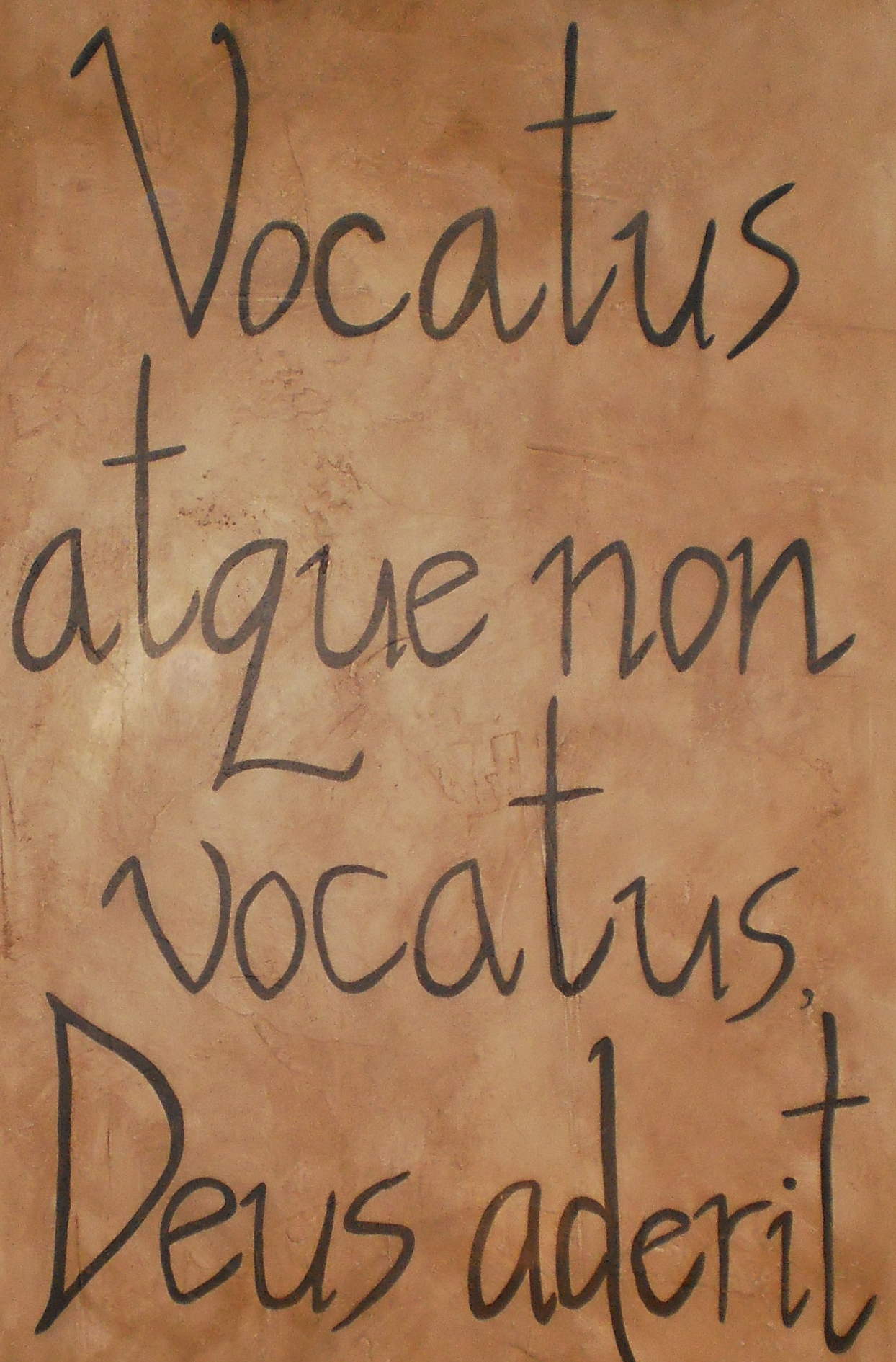 ent. The quote was famously carved above Jung’s door (and painted in my own house, as a reminder), and he said this about it: “It is a Delphic oracle though. It says: yes, the god will be on the spot, but in what form and to what purpose? I have put the inscription there to remind my patients and myself: Timor dei initium sapiente [‘The fear of the Lord is the beginning of wisdom.’] Here another not less important road begins, not the approach to “Christianity” but to God himself and this seems to be the ultimate question.”
For me, vocatus is God calling, God present, God inviting and luring. Like Jung’s insight about approaching God, the journey to discover our charisms is perhaps one of the central tasks in our life in God. We begin by listening, for God’s call begins with silence, with creating space in which to hear. In hearing the call we begin to enter wisdom; we enter the Mysteries.
Listen…what is God calling’s to you?
ent. The quote was famously carved above Jung’s door (and painted in my own house, as a reminder), and he said this about it: “It is a Delphic oracle though. It says: yes, the god will be on the spot, but in what form and to what purpose? I have put the inscription there to remind my patients and myself: Timor dei initium sapiente [‘The fear of the Lord is the beginning of wisdom.’] Here another not less important road begins, not the approach to “Christianity” but to God himself and this seems to be the ultimate question.”
For me, vocatus is God calling, God present, God inviting and luring. Like Jung’s insight about approaching God, the journey to discover our charisms is perhaps one of the central tasks in our life in God. We begin by listening, for God’s call begins with silence, with creating space in which to hear. In hearing the call we begin to enter wisdom; we enter the Mysteries.
Listen…what is God calling’s to you?
Vocatus
Like the crisscrossing trunks of the trees on the lawn my mind wanders here and there. Grounded by my roots of what it means to believe, to worship, to be the body of Christ but growing upward toward open sky. New horizons pull me to the blue. Sometimes I feel separated from the root, or split, as these trees are, into two arches reaching skyward and sometimes weighing each other down. All those branches grow each spring with leaves prolific, an ever expanding canopy that filters the sun and the rain to the green grass below. How can I resist growth and yearn for it at the same time? I feel both weary and alive, tired of upward movement yet energized to see farther into myself, into this crazy world. A restlessness that never leaves me, that I must use, toward the elusive Something More… I’ve grown pale these many years, settling at the roots and ignoring the sun that always calls my name. Always. I turn to the dark, prefer the cloudy days. The light hurts my eyes; it scares me to have to look at myself in such Brightness. And yet. And yet this call, to move toward what was always meant to be, toward the pain and surrender of being myself, of living into who I am and am to be. I can no longer bear the safety of silence, must move into the light, must feel the stretch of bone and muscle as they grow, the flex of movement. This tension is leading me toward wholeness toward myself, toward the world. The holding back is hurting me now. And so I let go. I fall into the open sky, into the great Unknown, and I begin to dance, heart and soul, to the divine Rhythm of call and celebration and creation made Whole.
I started cutting hair in college. We were all poor, and it didn’t seem like it could be that hard, right? I figured it was mostly geometry — angles and proportions and length. (Well, I learned quickly the shortcomings of my theory.) Often I would find myself, on a Saturday afternoon, with (mostly) guys lined up, cutting hair in the athletic dorm of my college. Luckily, they weren’t the most discriminating of clients. Over time practice, more than geometry, gave me a decent skill set, and it was only when I went to graduate school in California that I found my first real challenge. His name was Ian, and he had the most beautiful mane of thick, curly, long hair. No matter what I did, no matter how properly I analyzed the angles and cut appropriately, his hair would go crazy. In order to end up where he wanted his hair to be, I had to cut all out of proportion, trying to guess the way his waves would wander. In the end, success. But it took a little thinking outside my hair cutting box to get there.
Fast forward to marriage, and a husband who took to cutting his own hair in college. He accepted my offer to help smooth out the edges, so to speak, and before I knew it, I was his hairdresser. It was fun, and we would laugh. When our sons came along, I naturally cut their hair — didn’t make much sense to pay for haircuts, especially when we had no income to speak of. The challenges of cutting children’s hair, I learned, often involved squirming toddlers and sharp scissors, which don’t mix well. Nipped skin and tears ensued on more than one occassion. And my threat — if one of them just wouldn’t hold still — was that I was going to take them to a barber, the prospect of which apparently seemed much worse than the risk with me.
And so it goes. I still cut their hair, except my oldest son who now mostly cuts his own. Once in a while, he’ll ask for a little assistance. But he does just fine.
I’ve noticed, though, that everyone tends to ask for haircuts at the worst times — when I’m especially busy or stressed or dressed up (haircutting tends to ruin one’s outfit and demands a change afterward) or sleepy and, in all honesty, have little time or inclination to cut hair. My youngest son seems to be the most frequent offender at this. He often asks for haircuts when he doesn’t really need them — not long after I have already cut it and it hasn’t really grown that much. Only recently did I have a realization: subconsciously, I think, he asks for haircuts especially when I seem distant or unavailable, those times when I’m least able to be present to him. Something about cutting his hair brings me closer to him; haircuts equal love in some way. When I do cut his hair, he fusses and fidgets, but he does it with a smile and always, at the end, with a hug. Maybe haircuts a signal to me, to be present, to participate in his young life in a very physical, tangible way.
Once, many years ago, when my husband and I were in a really difficult place in our marriage, I was frustrated and talked about separating. He was quiet for a long while, because unlike me, who sometimes throws something out before thinking through the implications thoroughly, he weighs his words and doesn’t speak them without deep reflection. (I’ve gotten much better about this, by the way, mainly through his influence and a lot of time on my knees.) When he finally spoke, he didn’t ask why, or beg me to reconsider, or logically explain that separation would be a bad thing. He asked me with teary eyes, “Who would cut my hair?” Somehow, that broke through to me in a way that I don’t think anything else could have.
What is the language of love? I believe in the power of words, and I never get tired of being told that I am loved, whatever words may be used to say it. Yet over time, I’ve come to see that the truest language of love is complex and layered — words alone without the backbone of actions and intention are ultimately flat. Like haircuts and the demands thereof, love language involves being present, in the moment. Love equals intention; love requires that I think outside the box of words alone and delve into the messy business of risking myself, of being there and even delighting in the life of the Beloved. Love asks me, who will cut my hair? Who will take this role in my life, the action that no one else can do quite the same way. Of course, any number of people can cut my husband’s hair. But none can do it out of love as I can. Love’s that way — personal, showing up in the daily round of life, being a part of the fabric of another’s being.
I’m always irritated by that vacuous phrase ‘You complete me’. That’s not love, to me. That’s needy dependence, a failture to actually have one’s own life, always looking to another to do what I should seek to find within myself, within God. Like my favorite theologians U2 say, We’re one but we’re not the same/We get to carry each other. Love’s language allows for the complex interplay of being one with those we love yet not being the same. Only God can bring me to life, bring a kind of wholeness to me that otherwise is missing.
And I’m equally dismayed by the common notion in the Christian world that we only truly love, the deepest love, someone we marry. At least in this heart, love wears many faces. Marriage, indeed, carries certain specific parts of love that other relationships don’t — sex comes to mind, and a specific kind of fidelity. Marriage, it seems to me, is a commitment based on love but is not in itself love. It would be cruel of me to expect one person to meet all the needs I have; I truly don’t believe that is how we are built, if we are created in God’s image. The Triune God, after all, lives in an eternal dance of persons, Three in One and One in Three. Here is the fullness of love — always moving, open, seeing the Other for all their unique beauty.
Love’s language is, for me, best expressed when both my being and my bearing are open to another, in thought, word, and deed. Love, then, must listen for the little daily reminders that always come my way, calling me to listen, to respond, to slow down, to risk the messyness of haircuts and those other reminders of love coming near in the everyday.
Every day, believers around the world speak the words of the ancient creeds to articulate the core of the faith. I love these statements of faith; saying the Nicene Creed or the Apostles Creed ties me to the great cloud of witnesses who have gone before me and who will come after me. These words ground my faith, and when I may feel distant or doubtful, I’m held up by the common life I share with the broader community of the faithful in the world. The creeds tie us to one another and to the Church Universal.
Still, for me, it’s equally important to find words which delve into the particularity of my understanding of who God is, who Jesus is, who the Spirit is. I do this all the time through poetry and my own journals (and you can bet your bottom dollar that you won’t be reading either — well, maybe a poem someday). On more than one occasion, I’ve tried to write intentionally and reflect on the core beliefs that get me up every morning and keep me going through the day. A way to do this is to articulate my faith by writing my own creed, my own statement of faith. One such moment, written in 2006, is offered here. I might say some things differently now, but overall, I still believe this is a pretty good description of how I see God.
What would your Statement of Faith say?
My Unorthodox Statement of Faith
Standing at my own crossroads, I bow, kiss the earth, and confess:*
I believe in a chaotic universe that was created. One day my eyes will see as the Creator sees, not chaos but purpose. For in the chaos lies great beauty.
I believe that the purpose breaks through in fleeting moments, in the mystical.
I believe that I am a part of the whole, created with care, yet not with perfection.
I believe that God is the Creator of all that is and of even more that I don’t know, see, feel.
I believe God knows me by name, sees me from the inside out. God draws me to seek, to ask, to knock at the Mysteries.
I believe God has come in Spirit and in Flesh. This is one of the Mysteries.
I believe God is greater than anything I can wrap my mind around, but I keep trying. God wants to be known, is gracious enough to keep breaking though, bit by bit. My heart aches to see more. Another Mystery.
I believe God wants to be known so much that God took on my form on earth, Creator becoming a part of creation.
I believe that to save creation, God died while here on earth. Yet God still lives. Always has, always will. A huge Mystery.
I believe God acts most from a place of love and humility, even though God could do it otherwise.
I believe God is in the middle of all my hurt and pain; God hurts with the hurting.
I believe God hears the cry of a girl in the dark, abused and misused; cries with a mother when her daughter dies; weeps for the soldier who carelessly kills an innocent child out of his own rage and pain.
I believe God loves this measly world, even finds joy in the midst of the shit we’ve created here. And that joy is strangely contagious. It bubbles up within me at the least expected times and places.
I believe God wrestles with me and I am changed; maybe God is too. More Mystery.
I believe in the New Kingdom, which comes with the Spirit and will outlast this body, this time, this place, yet I will be a part of it forever. Still another Mystery.
I believe God is Miraculous, Inconceivable, Unutterable.
I believe God meets me at the Threshold, between all that I am and all that I was meant to be, and within me gives form to the Unutterable* through pen, bow, brush.
I believe God shows me only as much as I can take in at one time, drawing me to want more, like a woman hungry for bread when there is none or thirsty for water on a hot dry day.
I believe God can’t be contained in my systems, my constructs, my will, my world. But God wants to be in my heart, for God is love.
*In Crime and Punishment, before he confesses to the crime, Raskolnikov “suddenly recalled Sonia’s words, “Go to the cross roads, bow down to the people, kiss the earth, for you have sinned against it too, and say aloud to the whole world, ‘I am a murderer.’”” (Part VI, Chapter VIII, 25-27) Throughout the novel, Dostoevsky also uses the motif of standing in a threshold and of things being unutterable.
In spite of the fact that I’ve begun writing a blog, I actually have not, historically, been good at self-disclosure. It’s something I’m working on. And while this blog is not meant to be a sort of running diary, it does seem that to honestly explore the things I’m trying to explore requires allowing myself to be known more than I have in the past. Being known, for me, involves risk, trust, truth. I love to know others — people honestly interest and fascinate me. But when the shoe is on the other foot and people want to know me, my defenses kick in, and I am very careful about how much I reveal. It’s not even conscious. Deep in the folds and recesses of my brain, somewhere there is imprinted the mantra that to let people in is just too dangerous. (I realize the implications of that — and will leave it to therapy to explore someday.)
Now there are those few people in life with whom I just seem to click, and those relationships, whether they have been around for months or years, are the places where I begin to peel back the layers and allow people in. Some folks actually have come to know me, and when I have a chance to spend time with these few people in the world who really know me well, I’m so amazed at all the things which bubble up when we’re together, things that normally I keep inside.
Growing up, I was a solitary child. I lived in a world of books and music, of imagination and creativity, and sometimes of uncertainty. The world seemed to require more of me than I was quite prepared to give. It wasn’t really until I was in middle school that I began to branch out and broaden my landscape with people. Up to that point, my parents were the primary relationships in my life. Both my mother and father were warm, caring, and supportive. My mother was especially nurturing, and it is her love that, later in life, I have found myself returning to again and again as a picture of how to know and be known.
My first real friend, and still one of my truest, deepest friends, was Micki. We met when I was 2 and she was 3. My earliest memories of her were of a child who had all the toys she could ever dream of, the girl with white hair and all the attention. Instinctively, I was both drawn to her and repelled. Who could stand to be in the shadow of such a beam of sunshine? And that was my impression when I was just 4! It wasn’t until I started junior high that we ‘clicked’ and I began that journey of discovery — of another and of myself. We literally grew up together, sometimes in tension but mostly complimenting each other as we explored the boundaries of our respective worlds. Over the years, Micki and I have taught each other about those truest things in life — true joy for another, regret, sorrow, deep loss, redemption, forgiveness. Even now, all these years along the road, we discover new things together and revisit old times, seeing with new eyes things we failed to see in our youth. Early on, we realized, she and I, that we were ultimately realists, that we knew life was nowhere near perfect, that families were flawed, that lives could be forever damaged by passions and regrets and apathy and trauma. Together, there is a give and take to our friendship, a flow to knowing one another and to revealing ourselves as we move through our days and weeks and months and years.


The wonder of knowing and being known is that we all, even the most introverted and private of us, have an amazing capacity for connection. Like when a second (or third or fourth) child is born — just when I think my heart is too full to possibly love the next child as much as the last — my heart breaks open, is more than I knew it could be, and overflows with love. And love is at the heart of knowing (but that’s my next blog).
Knowing another person demands something of me. Sometimes I think that really knowing someone is mainly about always having deep, meaningful conversations. And those conversations do matter. But knowing someone also is about knowing that they like pink or don’t like orange, that cats drive them crazy or tomatoes delight, that they like to drive fast or hate onions or love red, that they secretly want to sing well but never believe they can, that they’re grouchy in the morning or love tea or like to flirt. (This list a mix of Micki and me — I’ll let the reader wonder which is which.) Knowing another means accepting that person in all their complexity and inconsistency, their tenderness and quirkiness and marvelous humanness. I have to be willing to put up with the uniqueness of another person who is often so different than myself.
Being known, though, calls me to put out. No hiding, no demurring from displaying my own sometimes strange and sometimes glorious way of seeing the world. The risk, of course, is not just rejection. That I can take — just let me know you don’t like me and move on. The real risk for me is closeness, is acceptance, is being loved in spite of and because of who I am: restless and poetic, spontaneous and messy, real and rowdy and smart and sassy and deeply flawed, but always trying to allow God to work it out in me, every morning, resurrected.
As Bilbo said to Frodo, “It’s a dangerous business, Frodo, going out your door….”
U2’s music, long a touchstone in my life, has a way of saying those things which weigh on me. One lyric which captures me these days is this:
Lights go down, it’s dark
The jungle is your head
Can’t rule your heart
A feeling is so much stronger than
A thought
Your eyes are wide
And though your soul
It can’t be bought
Your mind can wander
Seems like my mind is wandering a lot these days, and my head and heart may seem to be sometimes at odds. I want what I shouldn’t want; my desire seems to overtake my common sense. I see the path ahead, and if I’m not careful, I can wander right off into dark places where I should not be. Like St. Paul, I can’t seem to keep from doing what I know I shouldn’t do, or do the good I want to do. Eugene Peterson translates Paul’s words from Romans 7 like this: I can will it, but I can’t do it. I decide to do good, but I don’t really do it; I decide not to do bad, but then I do it anyway. My decisions, such as they are, don’t result in actions. Something has gone wrong deep within me and gets the better of me every time. There it is: something gets the better of me every time. My actions sometimes seem detached from my decisions. What’s a girl to do?
So I’ve been wondering about this tight little place where I so often find myself, between heart and head, body and spirit, desire and duty. It’s easy to jump to conclusions: one’s passions lead one astray. Feelings = bad; thought = good, that’s often the math we use when thinking about heart and head. When desire arouses something in me, I move toward it. That way lies danger, I say, but that way also lies discovery, I reply. (I like to have these little conversations with myself.)
Desire gets a bad rap, in my mind. And even as I read Paul’s logic about the law, I feel resistance. It’s easy to read a kind of dualism into the Pauline writings, a sense that we are created as two beings, a physical one and a spiritual one, at constant war within. And that doesn’t quite work for me. Why in the world would God become human, taking human form, if being human means being divided that way? What if the reason God in Christ chose to become human is this: to show the division as false, as a corruption of God’s original creative intention to make humankind in the very image of the triune Self: whole, body and soul and spirit, living out life in a divinely creative expression of all that was and is and is to be. Maybe, just maybe, by coming in flesh and blood, by being body and spirit, Jesus’ life serves to remind us and inspire us to learn from desire rather than turn away from it.
Feel like I’m going in a circle? I am, sort of. See, I suspect that it’s not desire and passion that get us into trouble, per se. I’m not simply a thinking, rational being who gets waylaid by these distracting emotions and desires and passions. Rather, the feeling of separation comes from the dualistic thinking that pushes me toward not being fully present to all that God made me to be: body, spirit, soul, filled with thought and reason and desire and passion, seeking always to find an outlet for the incredible fire that burns within, through word and song, through touch and feel, through beauty and ugliness and the wide range of experience that the world brings to bear on this life of mine. There is a give and take to life, and it requires of me an awareness; it demands that I show up and be present to all that is happening within me and around me.
I’m reminded of Pascal, and I want to sew into my own coat his words of longing: Fire. ‘God of Abraham, God of Isaac, God of Jacob,’ not of philosophers and scholars. Certainty, certainty, heartfelt, joy, peace. God of Jesus Christ. God of Jesus Christ. My God and your God. This is desire, this fire in the belly that pulls us, draws us to God. It might happen through the most unexpected and even forbidden ways: a forbidden love; a hidden moment of self-indulgence; the touch of someone unfamiliar and new; a glimpse of beauty; a moment of real truth between two people, with all its joy and pain and overpowering reality.
Now I’m not saying that I should or will pursue every desire that arises within me. That would truly be vanity of vanities. But maybe desire, that longing which I fear is pulling me toward the dark, is God’s own Holy Spirit, pulling at me from the inside, pushing me to recognize something new, something which I must acknowledge and sometimes experience in order to truly become who I am. Perhaps desire is meant to interrupt, to disturb and disrupt my status quo, to wake me up. For me, most often, the longing of desire takes me places where I can’t go with just part of myself. And always, this disequilibrium forces me to a place I’ve been before: before God, raw and real, on wobbly knees but with open heart. I’m a slow learner, with a tendency to wander. So God keeps enticing me with new desires. Desire drives me home, to the heart of God. If I let it.
U2 got it right, I think. Desire is Love calling to me, teaching me to be whole, which means to be in God. That drives me to my knees every time.
We’re at a place called Vertigo
Lights go down and all I know
Is that you give me something
I can feel your love teaching me how
Your love is teaching me how, how to kneel.
Ten days now, and the countdown has begun. On one level, I’m scurrying around trying to deal with details — who does what, who sleeps where, how to make some sort of order out of the chaos of boxes and books that surrounds me. And on a deeper level, I’m listening intently to the cacophony of internal chaos that rolls around in my soul.
What does it mean to take vows? I’ve done it before, more than once in my life. Standing at the altar, stained glass casting a luminous glow all around, young and dreamy eyed with flowers in my hair and my hands, throwing caution to the wind, I vowed to love another person until death, to care for each other in whatever circumstances life threw at us. As I said those words so many years ago, I made promises that in many ways I was completely unprepared to keep. And yet. And yet, as the hours turned to days and weeks and years, the words slowly became real, slowly seeped into the marrow of my life. Even after all these years, it is those vows which frame much of how I act and react, of how I relate to others and understand myself. And I’m quite certain that without making vows that day, I would never have been able to stay with the whole enterprise of living with another person for my whole life.
I vowed again, three times, not with words but with my very being, birthing three people into this world with an implicit vow to be with them, take care of them, love them and let go of them, help them be their truest self, for the rest of my days. Those vows were real and raw, wrought in the long months of growth and nurture as their bodies formed, and when the moment came, a fierce truth set into my soul that I would do anything to honor the silent vow of being a mother to these children. Through the long days and short years, my patience has been tested but never my deep knowing that this was a lifelong gig, one that changed me right up front and seems to keep me always dipping my foot in Heraclitus’ river, looking for constancy in the swift moving waters of change in my life. My feet are always wet, it seems.
Just six short months ago, before another altar, I knelt and vowed for my life to take on a new rhythm. We joked about it in seminary, the ‘ontological change’ that would happen at ordination. People asked me afterward if I felt anything when the bishop laid his hands on my head and called on the Holy Spirit to make me something I wasn’t. All I can say, as hokey as it sounds, is that yes, something happened in those moments – a sense of the weight of the words and of his hands, and in the stillness an incredible lightness, a knowing that this is what I am meant for, am made for, have been longing for my whole life. I was completely present and aware while also being lit from within and free from myself, embraced by Something More.
So now my mind turns to this next vow I am about to take, to be a priest in Christ’s one, holy, catholic, and apostolic Church. Am I ready? Do I know what in heaven’s name I am doing? These are not just words in a church, said for the sake of ritual and form. These vows are laying my soul naked before God, agreeing to once again be molded and formed, through fire and water and oil, into what God needs me to be in the world. Like marriage and motherhood, I likely have no idea what is in store for my life, what new rhythm will emerge. And yet, in the midst of this reality is the equally humbling certainty that I can’t not take this vow. This is who I am. And the knowing makes up for any lack. I am becoming. It is God who is at work in me, who is vowing to me that I am never alone, that every day, in every hour, God will give me exactly what I need to live out the vow I take.


 Entering the Mysteries